Today we will share examples of irony and use them to come up with a good answer to the question: What is the value of irony in argument?
Then, students will write their own multiple choice question for the final exam, using AP question stems, keeping in mind the different kinds of distractors that usually appear on the AP test.
REMINDER: the final exam will consist of 1) vocabulary test on lessons 1-7 2) multiple choice questions on "A Modest Proposal" and 3) an argument essay on a sample AP prompt.
Showing posts with label Satire. Show all posts
Showing posts with label Satire. Show all posts
Tuesday, December 17, 2013

Sunday, December 15, 2013
A classic example of SATIRE: "A Modest Proposal" by Jonathan Swift

Monday we will read Jonathan Swift's classic essay in class. As you read, your task is to keep track of examples of Swift's effective use of irony in his essay.
In partners, answer the Questions on pages 709-710: "Questions on Meaning" and "Questions on Writing Strategy" and "Questions on Language."
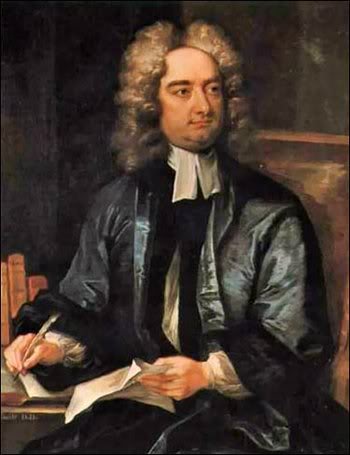
On Tuesday, you will analyze your examples of irony. For each example:
1. Decide whether the irony depends on UNDERSTATING (the presentation of something as being smaller, worse, or less important than it actually is.), OVERSTATING (hyperbole, exaggeration), or saying the opposite of what is meant.
2. How do they improve on literal statements?
3. Ultimately, what is the value of irony in argument?
A contemporary imitation of Swift's essay by Stephen Colbert: A Modest Porpoisal
Thursday, December 12, 2013
Introduction to Satire: for Friday after vocabulary test
We will use this video titled "Teenage Affluenza" as our introduction to SATIRE:
What fault in society is this video attempting to correct?
How does the use of satire enhance the message?
The following definition is from the website: http://web.cn.edu/kwheeler/lit_terms_S.html
What fault in society is this video attempting to correct?
How does the use of satire enhance the message?
The following definition is from the website: http://web.cn.edu/kwheeler/lit_terms_S.html
|
Subscribe to:
Posts (Atom)